Library Required reading Copy that sells
Every Line's Job Is to Get the Next One Read
Joseph Sugarman sold everything from pocket calculators to BluBlocker sunglasses with ads he wrote himself. His handbook is about as plain an account as you'll find of how copy carries a reader from the headline to the order.
Joseph Sugarman · The Adweek Copywriting Handbook · 2007
What it is
Sugarman ran his own mail-order company, JS&A, and wrote its ads and catalogs himself, so every line he wrote was tested against the orders it brought in. The handbook boils that down into a set of numbered axioms, and this is the best known:
“The sole purpose of the first sentence in an advertisement is to get you to read the second sentence.” Axiom 3, p. 33
What you’ll take from it
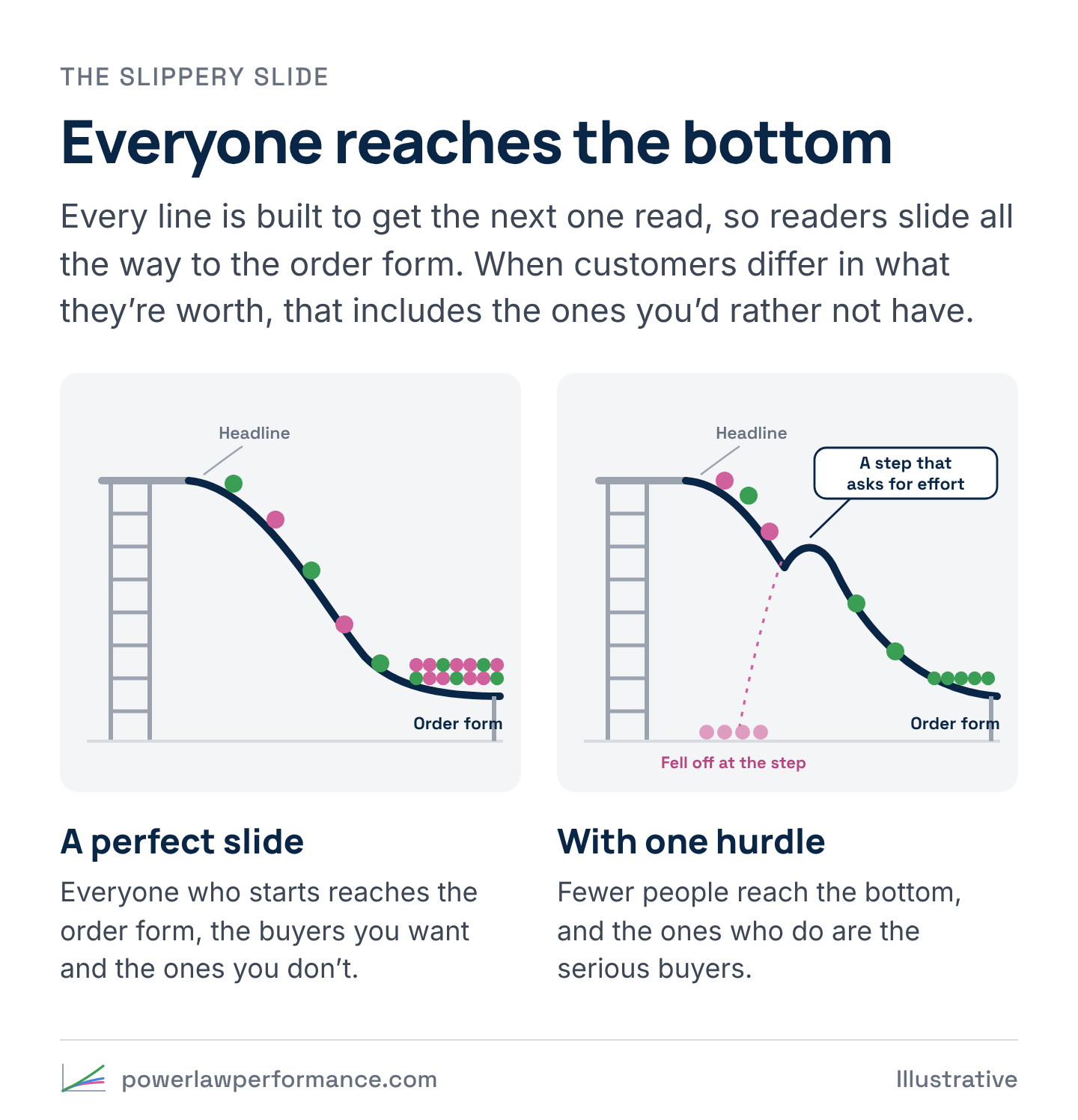
You’ll start reading copy as a sequence. Every element has one job, which is to get the reader to the next element. The headline gets the first sentence read, the first sentence gets the second read, and so on down what he calls the slippery slide, until the reader reaches the order form.
“That’s what the slippery slide is all about: getting your reader to read all of the copy.” Chapter 8, “The Slippery Slide,” p. 48
It’s the same shape as your funnel, and it takes the same discipline. Find the step where people fall off and fix that step.
Where it shows up in your numbers
Sugarman’s slide is built to get everyone to the bottom, and for most of what he sold, that was the right goal. But when your customers differ a lot in what they’re worth, a perfectly slippery slide brings everyone down it, including the buyers you’d rather not have.
So read him alongside the economists of screening. The best thing a step can do is ask for a little effort, the kind a serious buyer will make and a casual one won’t. Put a step like that in and fewer people make it to the bottom, but the ones who do are the buyers you wanted.
Next on the shelf Michael Masterson & John Forde, Great Leads