Library Required reading Copy that sells
The Desire You Aim At Decides Who Shows Up
Eugene Schwartz's argument in 1966 was that the want is already out there, shared by millions of people, and an ad's job is to find it and aim it at a product. It's also where the levels of customer awareness come from.
Eugene M. Schwartz · Breakthrough Advertising · 1966
What it is
A copywriter’s theory of why ads work, first published by Prentice-Hall in 1966 and reissued several times since, most recently in 2017.
Schwartz starts from the idea that advertising doesn’t create desire. The desire already exists, held by large numbers of people at once, and the ad’s work is to channel it. It finds a want that’s already there and connects it to the product.
What you’ll take from it
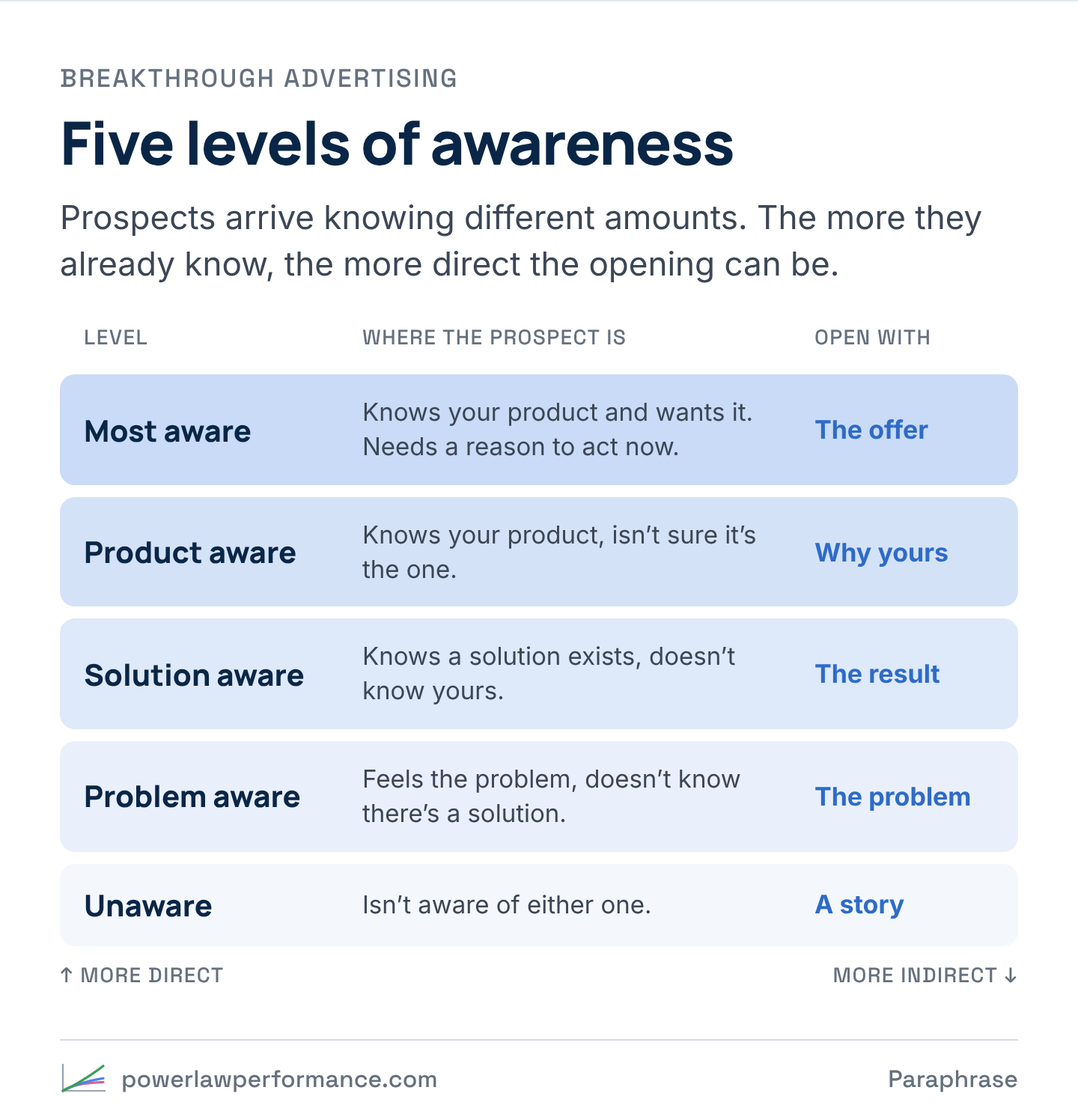
There are two ideas to take with you. The first is mass desire, above. The second is awareness, because prospects arrive knowing different amounts. Some already know the product and only need a reason to act now. Some know their problem but don’t know a solution exists. Some aren’t aware of either. Each one calls for a different opening, from a straight offer for the most aware to an indirect, story-led approach for the least. (Masterson and Forde built Great Leads on that ladder.)
Where it shows up in your numbers
If the ad channels a desire that’s already there, then the desire you choose decides who answers. Aim at the want for the right car and you draw buyers who were already looking for it. Aim at the want for something for nothing and you draw the people who most want something for nothing. That’s the Free Lamborghini in one sentence.
Schwartz gives you the vocabulary for the first decision your campaign makes, before any test runs. Which desire are you aiming at, and who holds it?
Schwartz isn’t quoted on this page because no passage could be checked against the book itself. The summary above is a paraphrase.
Next on the shelf David Ogilvy, Ogilvy on Advertising