Library Research Customer value, acquisition and retention
Don't Chase the Customers Most Likely to Leave
Who should get your save offer, the customers most likely to leave or the ones the offer will actually change? In two field experiments, Eva Ascarza found that aiming at the second group worked better.
Eva Ascarza, 2018
Extra drop in churn from targeting by response instead of by risk
What she was looking at
How does your retention program decide who gets the save offer? If it’s like most, a model scores every customer’s risk of leaving and the offer goes to the highest scores.
Eva Ascarza, a marketing professor, put that rule to the test in two field experiments:
- A prepaid wireless provider in the Middle East. 12,137 eligible customers were split at random, and the treated group got a text offering free credit when they recharged.
- A North American membership organization. Some renewal letters included a thank-you gift.
Then she used machine learning to estimate how much each customer responded to the offer, and compared two ways of picking who gets it, by risk of leaving or by predicted response to the offer.
What she found
“customers identified as having the highest risk of churning are not necessarily the best targets for proactive churn programs.” Ascarza (2018), abstract, p. 80
With the same campaign, targeting by response cut churn by an extra 4.1 percentage points in the first study and 8.7 in the second. And the customers most likely to leave and the customers the offer would actually change only overlapped by about half.
“retention programs are sometimes futile not because firms offer the wrong incentives but because they do not apply the right targeting rules.” Same
The paper won the American Marketing Association’s Paul E. Green Award for 2018.
What it means
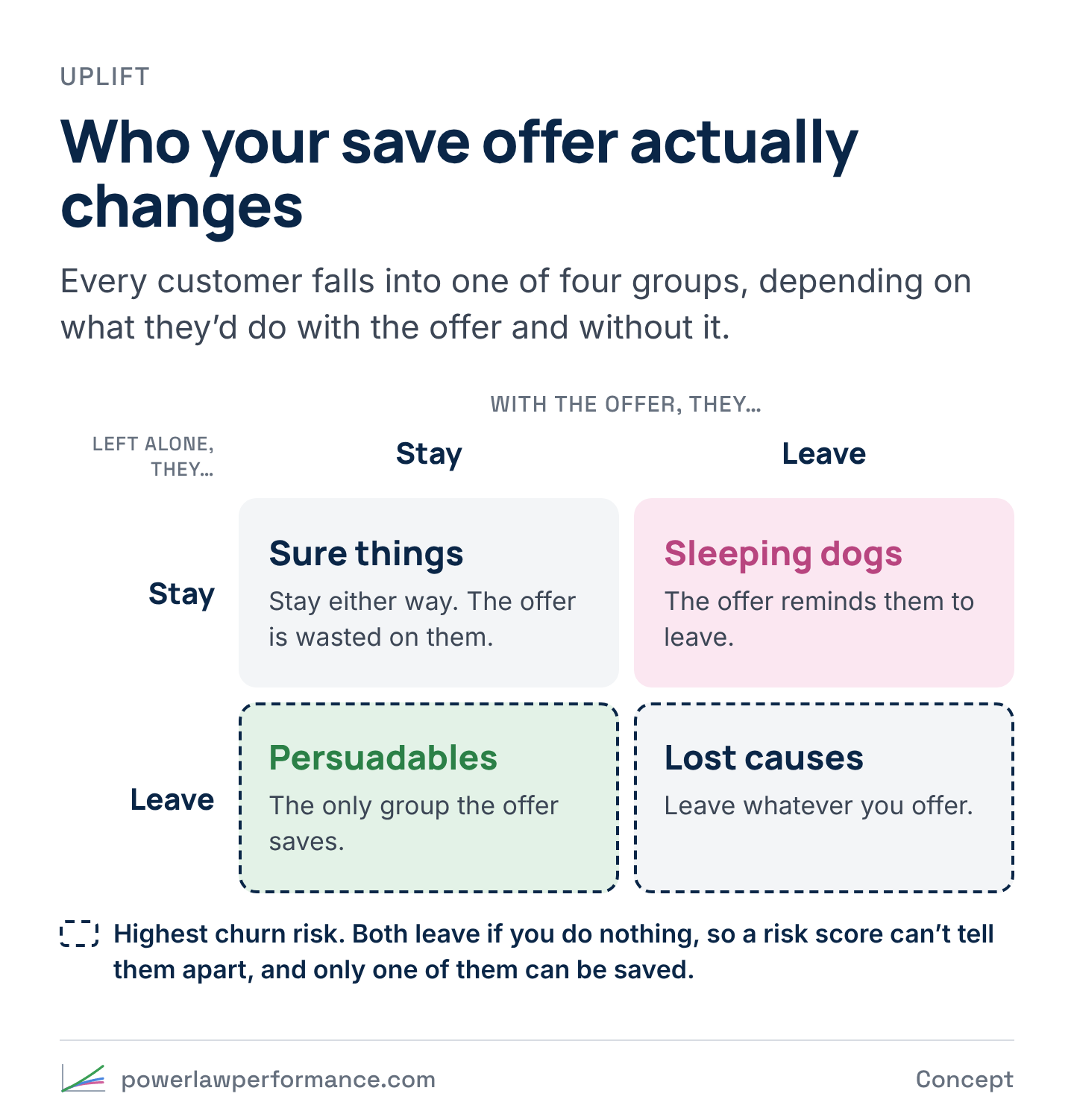
Who’s going to leave and who’s going to respond are two different questions. Some of your high-risk customers are leaving no matter what you offer them. Some of your low-risk customers were going to stay anyway. Your retention money only earns a return where it changes the outcome.
Related work makes the point even stronger. In one experiment, reaching out proactively to keep customers actually raised churn. Within three months, 10% of the contacted customers had left, against 6% of the ones nobody contacted.
Where it shows up in a revenue team
- Save campaigns aimed at your riskiest accounts spend a lot of money on customers who were leaving whatever you offered.
- Weight it by value, too. The customer you want to target is the one the effort changes, weighted by what that customer is worth to you.
- Keep a holdout. Leave a random slice of customers untreated, so you can see who the offer actually moved and not just who stayed.